Explore Solutions

Ideas to shift perspectives and paradigms.

Community First, Climate First Decision Making.

In every sector. At any age. Four key principles anchor community first, climate first decision-making:


Partner with the earth instead of dominating it.


Prioritize the most vulnerable people, species, and places.


Build community and connectivity to build climate resilience.


Use the prevention of climate change as the North Star for decision-making.

Key Topics, Key Solutions

Biodiversity

Conserve habitat above all else. Fight for a proprotional approach to 30x30 or 50x50 (see biodiversity section) on the planet as well as in your own city and community.

Indigenous Perspectives

Land back to Indigenous partners will also preserve native habitats and will expand the views of Indigenous people that prioritize kinship with the earth and all its creatures.

Water

Increase percolation to feed aquifers. Stop trapping water outside of the water system by using water bottles. Explore solutions: fog catchers, atmospheric water generation, and everything from grey water to swales. 

Climate

Imagine a fossil fuel free future. Reject any climate solution that bolsters fossil fuels. Phase out natural gas. Invest in nature-based solutions first. Be careful that technological solutions do not reproduce patterns and harms.

Equity

Build community and justice. Support those at the front lines in defining agendas and solutions. Only strong communities will be able to weather the changing climate. Recognize that work can happen through teaching, music, art, and business.

Food

Build a local food system. Support the creation of positions and institutions whose sole focus is securing a reliable food supply in the case of supply chain breakdown. To relocalize food, we need to preserve land. 

Built Environment

Listen to the messages of old infrastructure: depave, build with new materials, create multiple pathways, embed redundancy in systems. Break cycles of harm through the placement of locally unwanted land uses. Build equitable housing.

Ocean Health

Prioritize what the largest and smallest ocean creatures need and everything else will fall into place. Halt polluted urban runoff into the oceans and reengage with coastal wetlands for multiple benefit.

Scalable Solutions

Solutions for individuals, home, school, neighborhood, business, city, state, country, hemisphere, planet. Scalable, flexible, adaptable to multiple sectors, create positive ripple effects, and counter compounding negative impacts.

Decarbonize: eliminate fossil fuel and natural gas from your home, workplace, grid.


Percolate: Direct water down into the soil. Capture rainwater, de-pave surfaces, use grey water.


Deplastic: Remove as much plastic as possible. Plastic is a petroleum product and the handmaiden of the fossil fuel industry. It is toxic to people and the planet.

Plant Native Plants. In a pot, in your yard, at your business, at school, all over the city for pollinators and local biodiversity that benefit us all.

With any solution, ask yourself if it puts community and climate first, if it increases community and connectivity to build resilience, prioritizes the most vulnerable people, places, and species for the benefit of all, and uses climate change as the North star.

Climate Change and Biodiversity are bookends to all earth's systems infographic

The titles of the books above are the nine planetary boundaries that we must respect in order to preserve human life on the planet.

  • Prevent climate change and improve biodiversity on land and ocean, and everything else will follow.
  • See earth's systems as extensions of ourselves, earth's creatures as our kin, and earth as our only home.
  • Be like a bookend. Hold up the values and actions that put community and climate first in order to preserve life for ourselves and the planet.

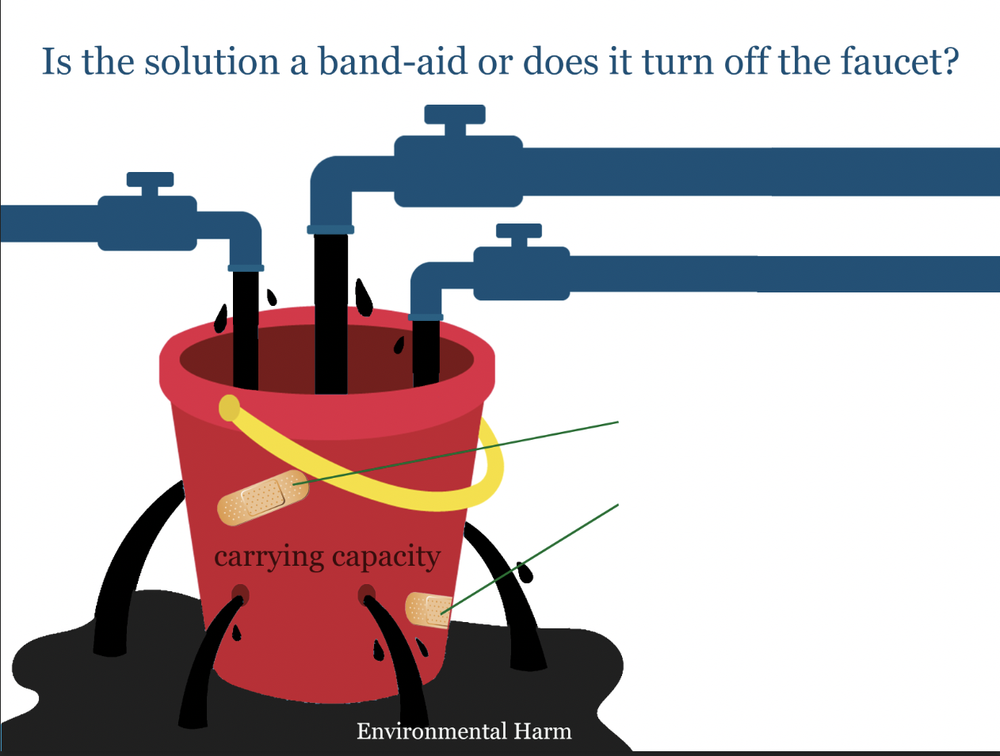
Band-Aids vs. Faucets

Flowcharts, memes, and infographics to help us ask ourselves...

"Is the solution a band-aid or does it turn off the faucet?"

How to use this activity in a classroom or at home:

Review the graphics and discuss which ones are band-aids or faucets. Then create a list of solutions to environmental problems and in your area and see if students can move band-aids to faucets or vice versa. What about in between?
Submit Flowcharts, Infographics, GIFs & Memes

Have an image which expanded your climate horizons that you'd like to share? Share the image file or copy/paste the URL below, and let us know what this image means to you.

Drop files here or
Accepted file types: jpg, gif, png, pdf, jpeg, webp, tiff, heic, Max. file size: 128 MB, Max. files: 12.
    Name

    More of our Favorite Models

    Below, we've gathered together some of our favorite approaches, models, and solutions.

    Additional Resources

    Project Regeneration and Project Drawdown are premier organizations that are guiding climate action at scales from local to global.